本页还没有译文
本页 62 段还没译成简体中文,下面显示的是英文原文。Sign in with Notion
还没翻译译自英文(supabase.com)本页 62 段都还没译
To enable Notion Auth for your project, you need to set up a Notion Application and add the Application OAuth credentials to your Supabase Dashboard.
Overview
Setting up Notion sign-in for your application consists of 3 parts:
- Create and configure a Notion Application Notion Developer Portal
- Retrieve your OAuth client ID and OAuth client secret and add them to your Supabase Project
- Add the sign-in code to your Supabase JS Client App
Create your notion integration
-
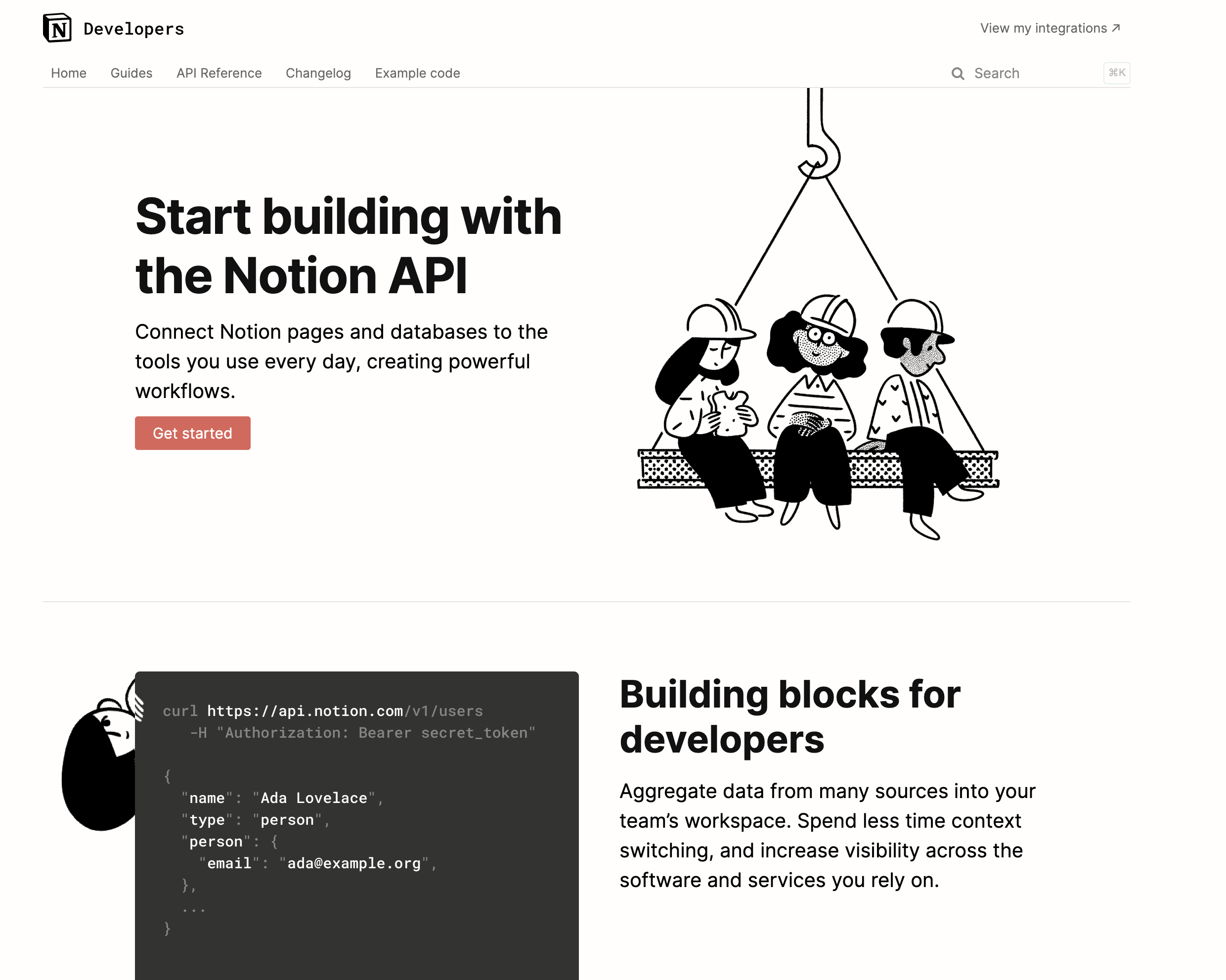
Go to developers.notion.com.
-
Click "View my integrations" and sign in.
-
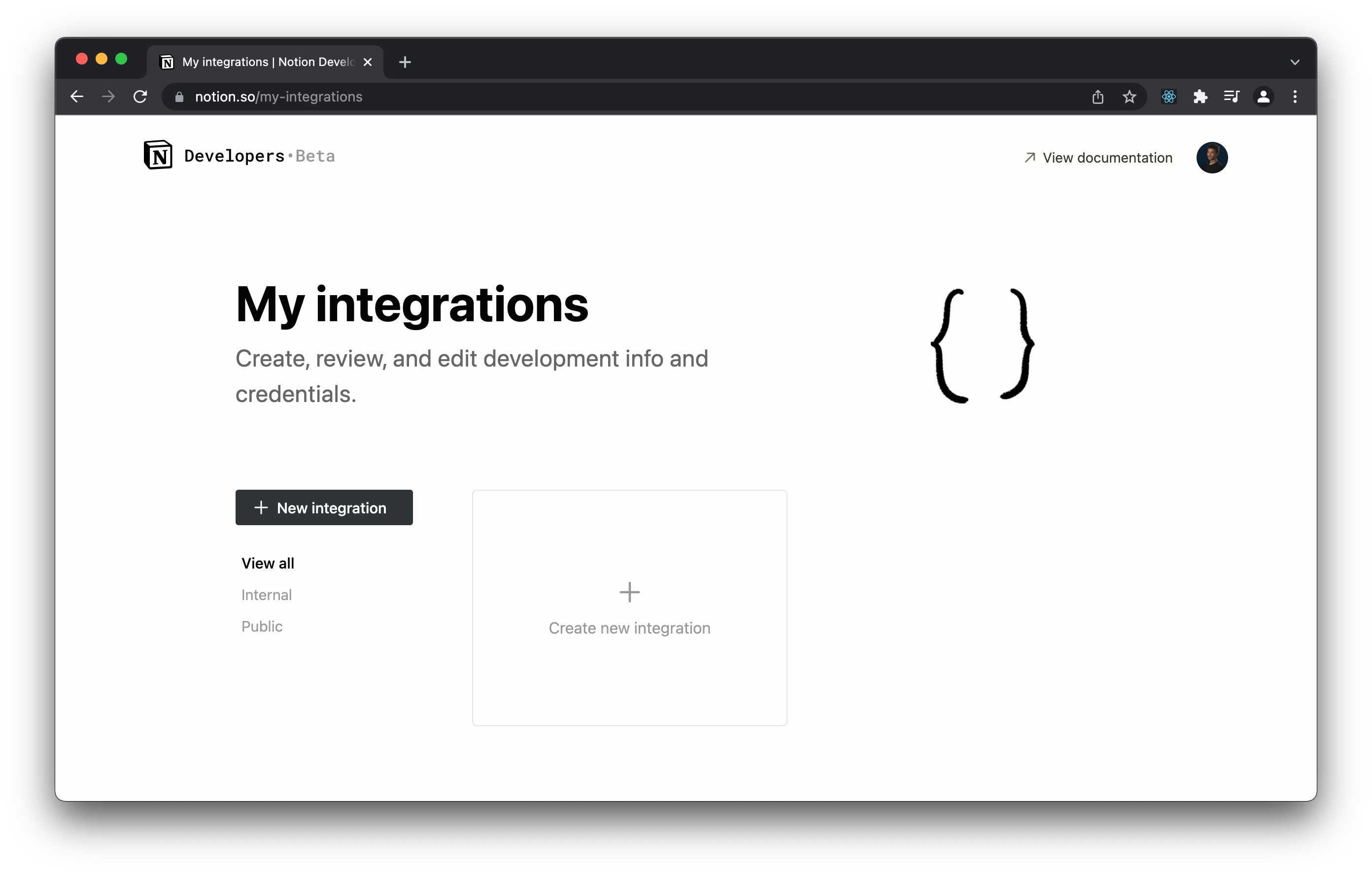
Once signed in, go to notion.so/my-integrations and create a new integration.
-
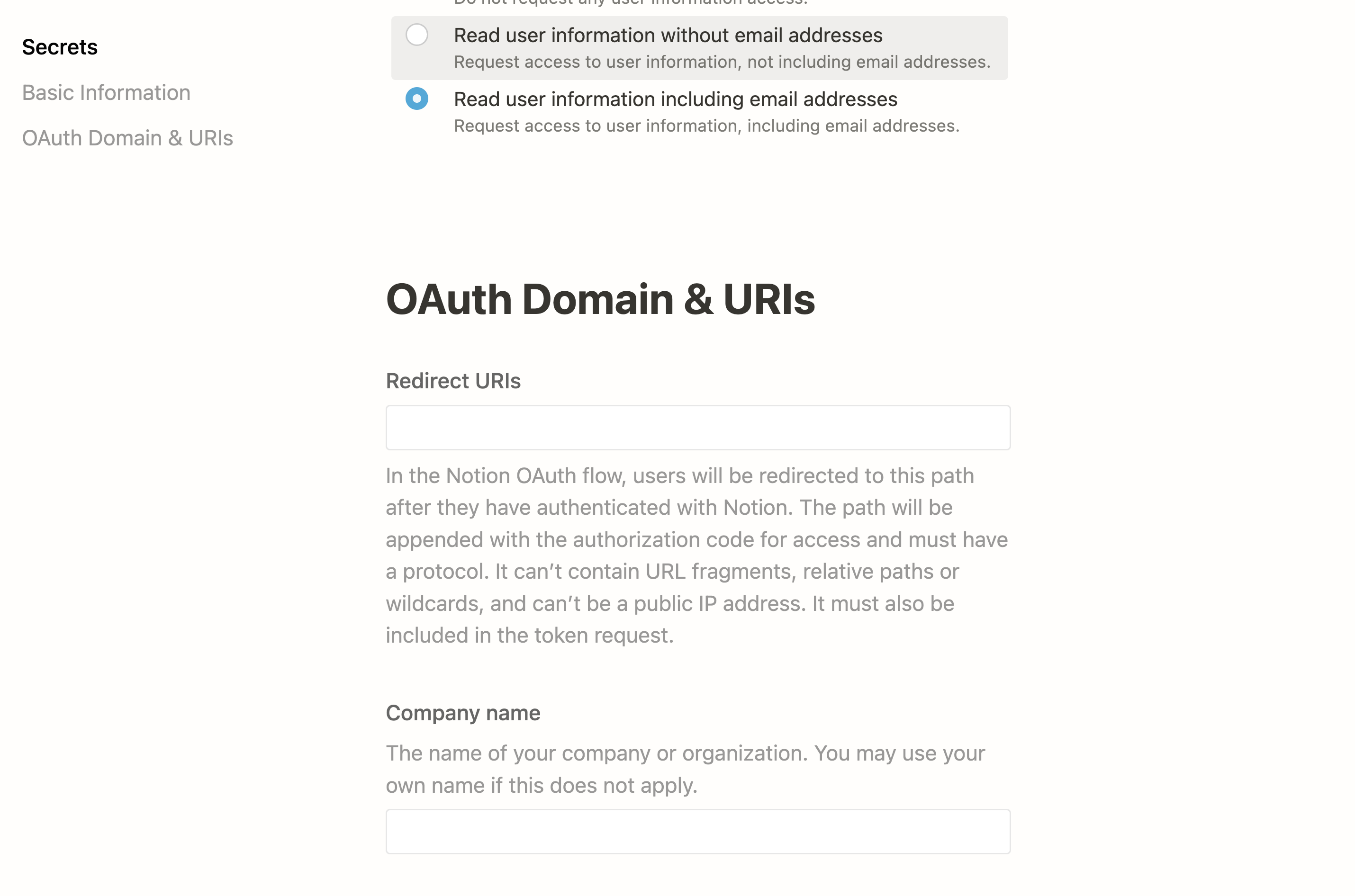
When creating your integration, ensure that you select "Public integration" under "Integration type" and "Read user information including email addresses" under "Capabilities".
-
You will need to add a redirect URI, see Add the redirect URI
-
Once you've filled in the necessary fields, click "Submit" to finish creating the integration.
Add the redirect URI
- After selecting "Public integration", you should see an option to add "Redirect URIs".
The next step requires a callback URL, which looks like this: https://<project-ref>.supabase.co/auth/v1/callback
- Go to your Supabase Project Dashboard
- Click on the
Authenticationicon in the left sidebar - Click on
Sign In / Providersunder the Configuration section - Click on Notion from the accordion list to expand and you'll find your Callback URL, you can click
Copyto copy it to the clipboard
Local development
When testing OAuth locally with the Supabase CLI, ensure your OAuth provider is configured with the local Supabase Auth callback URL:
http://localhost:54321/auth/v1/callback
If this callback URL is missing or misconfigured, OAuth sign-in may fail or not redirect correctly during local development.
See the local development docs for more details.
For testing OAuth locally with the Supabase CLI see the local development docs.
Add your Notion credentials into your Supabase project
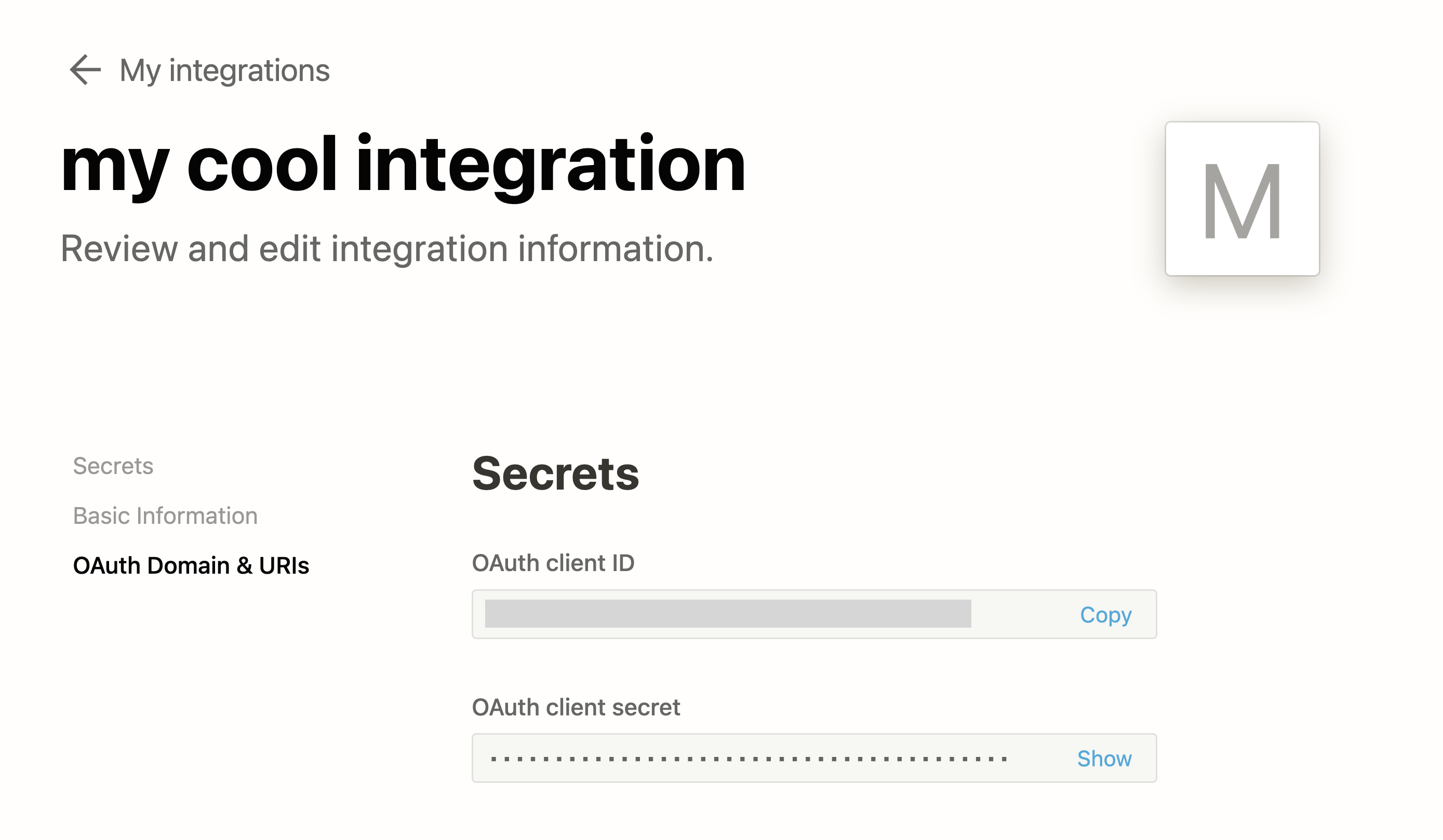
- Once you've created your notion integration, you should be able to retrieve the "OAuth client ID" and "OAuth client secret" from the "OAuth Domain and URIs" tab.
- Go to your Supabase Project Dashboard
- In the left sidebar, click the
Authenticationicon (near the top) - Click on
Providersunder the Configuration section - Click on Notion from the accordion list to expand and turn Notion Enabled to ON
- Enter your Notion Client ID and Notion Client Secret saved in the previous step
- Click
Save
Add sign-in code to your client app
Note
Make sure you're using the right supabase client in the following code.
If you're not using Server-Side Rendering or cookie-based Auth, you can directly use the createClient from @supabase/supabase-js. If you're using Server-Side Rendering, see the Server-Side Auth guide for instructions on creating your Supabase client.
When your user signs in, call signInWithOAuth() with notion as the provider:
import { createClient } from '@supabase/supabase-js'

const supabase = createClient('https://your-project-id.supabase.co', 'sb_publishable_...')

// ---cut---
async function signInWithNotion() {
  const { data, error } = await supabase.auth.signInWithOAuth({
    provider: 'notion',
  })
}
When your user signs in, call signInWithOAuth() with notion as the provider:
Future<void> signInWithNotion() async {
  await supabase.auth.signInWithOAuth(
    OAuthProvider.notion,
    redirectTo: kIsWeb ? null : 'my.scheme://my-host', // Optionally set the redirect link to bring back the user via deeplink.
    authScreenLaunchMode:
        kIsWeb ? LaunchMode.platformDefault : LaunchMode.externalApplication, // Launch the auth screen in a new webview on mobile.
  );
}
When your user signs in, call signInWith(Provider) with Notion as the Provider:
suspend fun signInWithNotion() {
	supabase.auth.signInWith(Notion)
}
When your user signs in, call SignIn() with Provider.Notion as the provider:
var state = await supabase.Auth.SignIn(Provider.Notion);
var signInUrl = state.Uri;
For a PKCE flow, for example in Server-Side Auth, you need an extra step to handle the code exchange. When calling signInWithOAuth, provide a redirectTo URL which points to a callback route. This redirect URL should be added to your redirect allow list.
In the browser, signInWithOAuth automatically redirects to the OAuth provider's authentication endpoint, which then redirects to your endpoint.
import { createClient, type Provider } from '@supabase/supabase-js';
const supabase = createClient('https://your-project-id.supabase.co', 'sb_publishable_...')
const provider = 'provider' as Provider

// ---cut---
await supabase.auth.signInWithOAuth({
  provider,
  options: {
    redirectTo: `http://example.com/auth/callback`,
  },
})
In the server, you need to handle the redirect to the OAuth provider's authentication endpoint. The signInWithOAuth method returns the endpoint URL, which you can redirect to.
Caution
Use a server client from @supabase/ssr, and send its cookies with the redirect. signInWithOAuth stores the PKCE code verifier in a cookie. When that Set-Cookie header doesn't reach the browser, the callback can't exchange the code for a session.
import { createServerClient, parseCookieHeader, serializeCookieHeader } from '@supabase/ssr'
import type { Provider } from '@supabase/supabase-js'

// A route handler that receives the incoming Request
async function handler(request: Request) {
  const headers = new Headers()
  const provider = 'provider' as Provider

  const supabase = createServerClient('https://your-project-id.supabase.co', 'sb_publishable_...', {
    cookies: {
      getAll() {
        return parseCookieHeader(request.headers.get('Cookie') ?? '') as {
          name: string
          value: string
        }[]
      },
      setAll(cookiesToSet, cacheHeaders) {
        cookiesToSet.forEach(({ name, value, options }) =>
          headers.append('Set-Cookie', serializeCookieHeader(name, value, options))
        )
        Object.entries(cacheHeaders).forEach(([key, value]) => headers.set(key, value))
      },
    },
  })

  const { data, error } = await supabase.auth.signInWithOAuth({
    provider,
    options: {
      redirectTo: 'http://example.com/auth/callback',
    },
  })

  if (error) {
    throw error
  }

  // Redirect with `headers` so the browser stores the code verifier cookie.
  // Frameworks usually wrap this, for example `redirect(data.url, { headers })` in Remix.
  headers.set('Location', data.url)
  return new Response(null, { status: 303, headers })
}
When your framework sets cookies on the response for you, such as cookies() in Next.js or event.cookies in SvelteKit, write to that API in setAll instead. The cookie is then already on the response, and the redirect needs no extra headers.
At the callback endpoint, handle the code exchange to save the user session.
Create a new file at app/auth/callback/route.ts and populate with the following:
import { NextResponse } from 'next/server'

// The client you created from the Server-Side Auth instructions
import { createClient } from '@/utils/supabase/server'

export async function GET(request: Request) {
  const { searchParams, origin } = new URL(request.url)
  const code = searchParams.get('code')
  // if "next" is in param, use it as the redirect URL
  let next = searchParams.get('next') ?? '/'
  if (!next.startsWith('/')) {
    // if "next" is not a relative URL, use the default
    next = '/'
  }

  if (code) {
    const supabase = await createClient()
    const { error } = await supabase.auth.exchangeCodeForSession(code)
    if (!error) {
      const forwardedHost = request.headers.get('x-forwarded-host') // original origin before load balancer
      const isLocalEnv = process.env.NODE_ENV === 'development'
      if (isLocalEnv) {
        // we can be sure that there is no load balancer in between, so no need to watch for X-Forwarded-Host
        return NextResponse.redirect(`${origin}${next}`)
      } else if (forwardedHost) {
        return NextResponse.redirect(`https://${forwardedHost}${next}`)
      } else {
        return NextResponse.redirect(`${origin}${next}`)
      }
    }
  }

  // return the user to an error page with instructions
  return NextResponse.redirect(`${origin}/auth/auth-code-error`)
}
Create a new file at src/routes/auth/callback/+server.js and populate with the following:
import { redirect } from '@sveltejs/kit'

export const GET = async (event) => {
  const {
    url,
    locals: { supabase },
  } = event
  const code = url.searchParams.get('code')
  const next = url.searchParams.get('next') ?? '/'

  if (code) {
    const { error } = await supabase.auth.exchangeCodeForSession(code)
    if (!error) {
      redirect(303, `/${next.slice(1)}`)
    }
  }

  // return the user to an error page with instructions
  redirect(303, '/auth/auth-code-error')
}
Create a new file at src/pages/auth/callback.ts and populate with the following:
import { createServerClient, parseCookieHeader } from '@supabase/ssr'
import { type APIRoute } from 'astro'

export const GET: APIRoute = async ({ request, cookies, redirect }) => {
  const requestUrl = new URL(request.url)
  const code = requestUrl.searchParams.get('code')
  const next = requestUrl.searchParams.get('next') || '/'

  if (code) {
    const supabase = createServerClient(
      import.meta.env.PUBLIC_SUPABASE_URL,
      import.meta.env.PUBLIC_SUPABASE_PUBLISHABLE_KEY,
      {
        cookies: {
          getAll() {
            return parseCookieHeader(Astro.request.headers.get('Cookie') ?? '')
          },
          setAll(cookiesToSet, _headers) {
            cookiesToSet.forEach(({ name, value, options }) =>
              Astro.cookies.set(name, value, options)
            )
          },
        },
      }
    )

    const { error } = await supabase.auth.exchangeCodeForSession(code)

    if (!error) {
      return redirect(next)
    }
  }

  // return the user to an error page with instructions
  return redirect('/auth/auth-code-error')
}
Create a new file at app/routes/auth.callback.tsx and populate with the following:
import { redirect, type LoaderFunctionArgs } from '@remix-run/node'
import { createServerClient, parseCookieHeader, serializeCookieHeader } from '@supabase/ssr'

export async function loader({ request }: LoaderFunctionArgs) {
  const requestUrl = new URL(request.url)
  const code = requestUrl.searchParams.get('code')
  const next = requestUrl.searchParams.get('next') || '/'
  const responseHeaders = new Headers()

  if (code) {
    const supabase = createServerClient(
      process.env.SUPABASE_URL!,
      process.env.SUPABASE_PUBLISHABLE_KEY!,
      {
        cookies: {
          getAll() {
            return parseCookieHeader(request.headers.get('Cookie') ?? '')
          },
          setAll(cookiesToSet, cacheHeaders) {
            cookiesToSet.forEach(({ name, value, options }) =>
              responseHeaders.append('Set-Cookie', serializeCookieHeader(name, value, options))
            )
            Object.entries(cacheHeaders).forEach(([key, value]) => responseHeaders.set(key, value))
          },
        },
      }
    )

    const { error } = await supabase.auth.exchangeCodeForSession(code)

    if (!error) {
      return redirect(next, { headers: responseHeaders })
    }
  }

  // return the user to an error page with instructions
  return redirect('/auth/auth-code-error', { headers: responseHeaders })
}
Create a new route in your express app and populate with the following:
...
app.get("/auth/callback", async function (req, res) {
  const code = req.query.code
  const next = req.query.next ?? "/"

  if (code) {
    const supabase = createServerClient(
      process.env.SUPABASE_URL,
      process.env.SUPABASE_PUBLISHABLE_KEY, {
    cookies: {
      getAll() {
        return parseCookieHeader(req.headers.cookie ?? '')
      },
      setAll(cookiesToSet, headers) {
        cookiesToSet.forEach(({ name, value, options }) =>
          res.appendHeader('Set-Cookie', serializeCookieHeader(name, value, options))
        )
        Object.entries(headers).forEach(([key, value]) =>
          res.setHeader(key, value)
        )
      },
    },
  })
    await supabase.auth.exchangeCodeForSession(code)
  }

  res.redirect(303, `/${next.slice(1)}`)
})When your user signs out, call signOut() to remove them from the browser session and any objects from localStorage:
import { createClient } from '@supabase/supabase-js'

const supabase = createClient('https://your-project-id.supabase.co', 'sb_publishable_...')

// ---cut---
async function signOut() {
  const { error } = await supabase.auth.signOut()
}
When your user signs out, call signOut() to remove them from the browser session and any objects from localStorage:
Future<void> signOut() async {
  await supabase.auth.signOut();
}
When your user signs out, call signOut() to remove them from the browser session and any objects from localStorage:
suspend fun signOut() {
	supabase.auth.signOut()
}
When your user signs out, call SignOut() to remove them from the browser session and any objects from local storage:
await supabase.Auth.SignOut();