本页还没有译文
本页 32 段还没译成Español,下面显示的是英文原文。Tutorial 04 - Agent-to-Agent Communication
还没翻译译自英文(docs.gascity.com)本页 32 段都还没译
Earlier tutorials had you talking to agents — peeking at output, nudging
sessions. This one covers how agents talk to each other. To follow along you
need my-city running with my-project rigged and agents for mayor and
reviewer (the setup from Tutorial 03).
Agents coordinate only through the store
Agents never reference each other. No function calls, no shared memory, no
handles — each session is its own process with its own terminal, history, and
provider. They coordinate through two indirect channels: mail (messages) and
slung work — gc sling (delegated tasks). In both, the sender names a
destination and Gas City routes it; the sender never holds a reference to who
receives it.
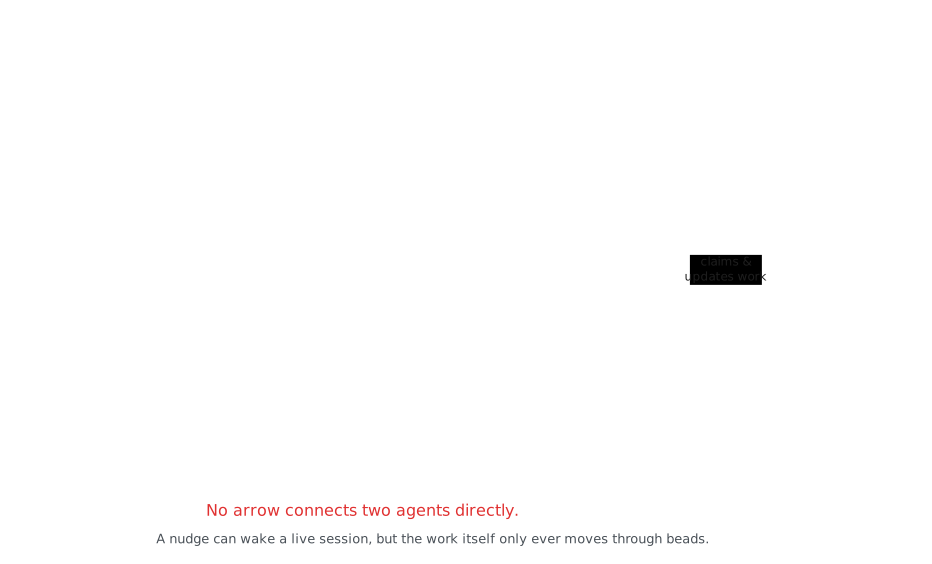
That indirection is the point. The mayor slings work to my-project/reviewer
without knowing whether one reviewer session exists or five, whether it runs on
Claude or Codex, or whether it's active or idle. Work and messages persist in the
store; sessions come and go independently — they can run, idle, restart, and
scale without breaking anyone's reference, because there are none.
Mail is a persistent, tracked message
Mail creates a message the recipient picks up on its next turn. It contrasts with nudge from Tutorial 03:
| Nudge | ||
|---|---|---|
| Carrier | A bead in the store | Terminal input |
| Survives a crash | Yes | No |
| Subject line | Yes | No |
| Wakes the recipient | No by itself; --notify can request a managed wake | Yes |
| State | Stays unread until processed | Fire-and-forget |
Send mail to the mayor:
~/my-city
$ gc mail send mayor -s "Review needed" -m "Please look at the auth module changes in my-project"
Sent message mc-msg-8t8 to mayor
gc mail send takes the recipient as a positional argument and the subject/body
via -s/-m flags. (You can also pass just <to> <body> with no subject.)
Mail does not create wake demand by itself. Add --notify to request a turn for
the recipient even when earlier mail is still unread. In a managed city, that
request can wake a non-running recipient; an unmanaged city queues the nudge for
later delivery; without a city store the nudge is skipped.
Check for unread mail:
~/my-city
$ gc mail check mayor
1 unread message(s) for mayor
See the inbox:
~/my-city
$ gc mail inbox mayor
ID          FROM   SUBJECT        BODY
mc-msg-8t8  human  Review needed  Please look at the auth module changes in my-project
gc mail inbox lists only unread messages, so there's no STATE column —
everything listed is unread by definition.
If you want to see the mayor react right away in peek or logs, give it a
turn:
~/my-city
$ gc session nudge mayor "Check mail and hook status, then act accordingly"
Nudged mayor
(As in Tutorial 03, you may see Queued nudge for mayor instead — both
confirm the nudge is on its way.)
The nudge doesn't deliver the mail — it only starts a new turn. The delivery
happens via a hook: on each turn, gc mail check --inject runs and any unread
mail appears as a system reminder in the agent's context. So the mayor never
checks its inbox manually; the hook surfaces mail, and the nudge tells it to act
on what it finds.
Slung work delegates a task without naming a session
Once the mayor takes a turn, it reads your mail, decides the reviewer should handle it, and slings the work:
~/my-city
$ gc session peek mayor --lines 6
[mayor] Got mail: "Review needed" — auth module changes in my-project
[mayor] Routing to my-project/reviewer...
[mayor] Running: gc sling my-project/reviewer "Review the auth module changes"
(The above is illustrative — peek returns the actual terminal contents of the
session, so you'll see whatever the agent has rendered, not Gas City–formatted
lines.)
The mayor slung a bead to the rig-scoped my-project/reviewer agent and Gas
City resolved the rest: it woke the reviewer if asleep, or routed to an
available session if several existed. The mayor describes the work and slings
it; routing is not its problem.
This is the pattern that scales: a human mails the mayor, the mayor plans and slings tasks to agents, agents do the work and close their beads — every hop through the store.
Hooks wire a bare provider into Gas City
Without hooks, a session is just a provider process — Claude in a terminal, with no awareness of Gas City. Hooks wire the provider's event system in so agents receive mail, pick up slung work, and drain queued nudges automatically.
gc init wires Claude's hooks for you: it writes a managed .gc/settings.json
that Claude reads on every session start. No TOML in pack.toml or city.toml
is needed for the default behavior — grep install_agent_hooks in a fresh city
turns up nothing.
Claude is the only provider wired automatically. To run an agent on a different
provider — say you moved the mayor to Codex — list that provider in
install_agent_hooks on the agent, and Gas City installs its hook files into the
agent's working directory:
# agents/mayor/agent.toml — install hook files for this agent's provider
install_agent_hooks = ["codex"]
Agent-local overrides live in agents/<name>/agent.toml. (You can also set
install_agent_hooks under [workspace] in city.toml as a city-wide
default, but that spelling is deprecated — config load warns and points you
at the per-agent form — and an agent-level list replaces the workspace one
rather than adding to it.)
Either way, once a session starts Gas City installs the hook settings the
provider reads. For Claude that's .gc/settings.json, which fires Gas City
commands at key moments — session start, before each turn, and right before the
provider compacts its context. Those commands surface pending work, deliver
mail, drain queued nudges, and save a handoff before a context cycle. Without
them you'd run gc mail check and gc prime by hand on every agent.
What's next
You've seen the two coordination mechanisms — mail for messages and slung beads for work — and the hook infrastructure that wires it all together. From here:
- The six primitives — the canonical model mail, slung work, and hooks build on
- Formulas — how multi-step work should be done: steps, dependencies, and variables
- Beads — the work tracking system underneath it all