Monitor BytePlus model inference with Langfuse
Observability for BytePlus with Langfuse
This guide shows you how to integrate BytePlus with Langfuse. BytePlus API endpoints for chat, language and code, images, and embeddings are fully compatible with OpenAI's API. This allows us to use the Langfuse OpenAI drop-in replacement to trace all parts of your application.
What is BytePlus? BytePlus is a suite of AI-powered APIs and services developed by ByteDance, including speech, video, and recommendation technologies. Langfuse integrates with BytePlus to trace and evaluate LLM workflows that use BytePlus tools, enabling observability across generation and user interaction.
What is Langfuse? Langfuse is an open source AI engineering platform that helps teams trace API calls, monitor performance, and debug issues in their LLM applications. Use Langfuse Cloud (hosted by Langfuse, free tier, no infrastructure to run) or self-host it.
Note
Note: You can also use BytePlus models in the Langfuse Playground and for LLM-as-a-Judge evaluations using the OpenAI adapter. Find out how to set up an LLM Connection in Langfuse here.
Step 1: Install Dependencies
Make sure you have installed the necessary Python packages:
%pip install openai langfuseStep 2: Set Up Environment Variables
Next, set up your Langfuse API keys. You can get these keys by signing up for a free Langfuse Cloud account or by self-hosting Langfuse. These environment variables are essential for the OpenAI drop-in replacement to authenticate and send data to your Langfuse project.
Find a guide on creating your BytePlus API keys for model services here.
import os

# Get keys for your project from the project settings page: https://cloud.langfuse.com
os.environ.setdefault("LANGFUSE_PUBLIC_KEY", "pk-lf-...");
os.environ.setdefault("LANGFUSE_SECRET_KEY", "sk-lf-...");
os.environ.setdefault("LANGFUSE_BASE_URL", "https://cloud.langfuse.com"); # 🇪🇺 EU region
# Other Langfuse data regions include 🇺🇸 US: https://us.cloud.langfuse.com, 🇯🇵 Japan: https://jp.cloud.langfuse.com and ⚕️ HIPAA: https://hipaa.cloud.langfuse.com

# Get your BytePlus API key from the project settings page
os.environ.setdefault("ARK_API_KEY", "***");
Step 3: Langfuse OpenAI drop-in Replacement
In this step we use the native OpenAI drop-in replacement by importing from langfuse.openai import openai.
To start using BytePlus models with OpenAI's client libraries, pass in your BytePlus API key to the api_key option, and change the base_url to https://ark.ap-southeast.bytepluses.com/api/v3:
# instead of import openai:
from langfuse.openai import openai

client = openai.OpenAI(
  api_key=os.environ.get("ARK_API_KEY"),
  base_url="https://ark.ap-southeast.bytepluses.com/api/v3",
)
Note: The OpenAI drop-in replacement is fully compatible with the Low-Level Langfuse Python SDKs and @observe() decorator to trace all parts of your application.
Step 4: Run An Example
The following cell demonstrates how to call the Kimi K2 model via BytePlus using the traced OpenAI client. All API calls will be automatically traced by Langfuse.
# Non-streaming:
print("----- standard request -----")
completion = client.chat.completions.create(
    # Specify the Ark Inference Point ID that you created, which has been changed for you here to your Endpoint ID
    model="kimi-k2-250711",
    messages=[
        {"role": "system", "content": "You're an AI assistant"},
        {"role": "user", "content": "What is Langfuse?"},
    ],
    name = "BytePlus-Generation" # Optional: Set the name of the generation in Langfuse
)
print(completion.choices[0].message.content)
# Streaming:
print("----- streaming request -----")
stream = client.chat.completions.create(
# Specify the Ark Inference Point ID that you created, which has been changed for you here to your Endpoint ID
model="kimi-k2-250711",
messages=[
{"role": "system", "content": "You're an AI assistant"},
{"role": "user", "content": "What is Langfuse?"},
],
name = "BytePlus-Generation", # Optional: Set the name of the generation in Langfuse
# Whether the response content is streamed back
stream=True,
)
for chunk in stream:
if not chunk.choices:
continue
print(chunk.choices[0].delta.content, end="")
print()Step 5: See Traces in Langfuse
After running the example model call, you can see the traces in Langfuse. You will see detailed information about your BytePlus API calls, including:
- Request parameters (model, messages, temperature, etc.)
- Response content
- Token usage statistics
- Latency metrics
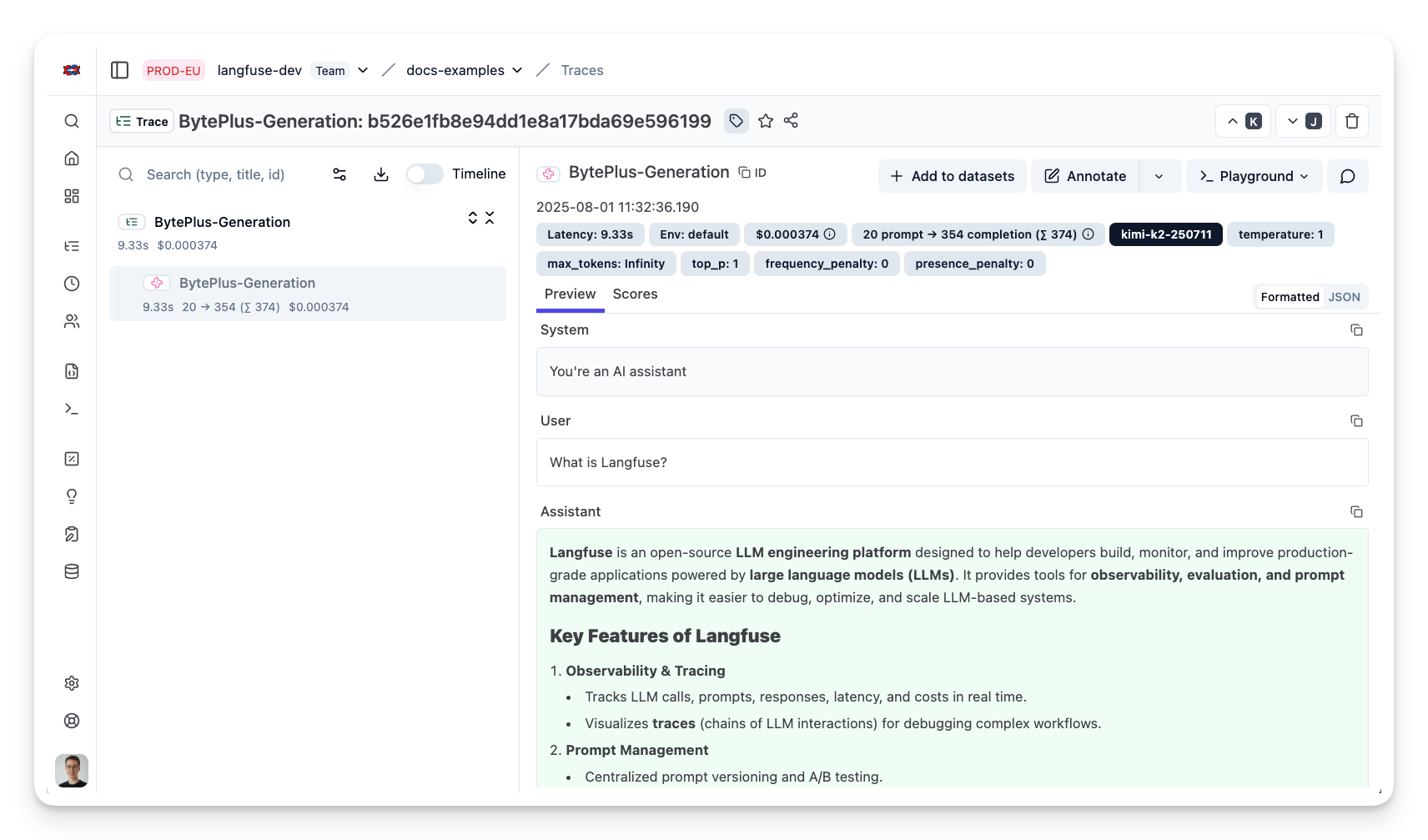
Public example trace link in Langfuse
Interoperability with the Python SDK
You can use this integration together with the Langfuse SDKs to add additional attributes to the observation.
The @observe() decorator provides a convenient way to automatically wrap your instrumented code and add additional attributes to the observation.
from langfuse import observe, propagate_attributes, get_client

langfuse = get_client()

@observe()
def my_llm_pipeline(input):
    # Add additional attributes (user_id, session_id, metadata, version, tags) to all spans created within this execution scope
    with propagate_attributes(
        user_id="user_123",
        session_id="session_abc",
        tags=["agent", "my-observation"],
        metadata={"email": "user@langfuse.com"},
        version="1.0.0"
    ):

        # YOUR APPLICATION CODE HERE
        result = call_llm(input)

        return result

# Run the function
my_llm_pipeline("Hi")
Learn more about using the Decorator in the Langfuse SDK instrumentation docs.
The Context Manager allows you to wrap your instrumented code using context managers (with with statements), which allows you to add additional attributes to the observation.
from langfuse import get_client, propagate_attributes

langfuse = get_client()

with langfuse.start_as_current_observation(
    as_type="span",
    name="my-observation",
    trace_context={"trace_id": "abcdef1234567890abcdef1234567890"},  # Must be 32 hex chars
) as observation:

    # Add additional attributes (user_id, session_id, metadata, version, tags)
    # to all observations created within this execution scope
    with propagate_attributes(
        user_id="user_123",
        session_id="session_abc",
        metadata={"experiment": "variant_a", "env": "prod"},
        version="1.0",
    ):
        # YOUR APPLICATION CODE HERE
        result = call_llm("some input")

# Flush events in short-lived applications
langfuse.flush()
Learn more about using the Context Manager in the Langfuse SDK instrumentation docs.
Troubleshooting
Next Steps
Once you have instrumented your code, you can manage, evaluate and debug your application:
Manage prompts in Langfuse Add evaluation scores Run LLM-as-a-judge Evaluators Create datasets Create custom dashboards Test queries in the Playground