Coming from Coding Agents
You know these capabilities from coding agents (Claude Code, Codex, Gemini CLI, Cursor, …) as features of a single agent. In Gas City they are infrastructure shared across many agents. Here is the quick map, ordered from the most basic to the most multi-agent.
| Capability | Coding agents (Claude Code, Codex, …) | Gas City |
|---|---|---|
| Context | The window you fill: CLAUDE.md, open files, chat, … | An agent role, plus injected work items and mail (all beads) |
| State | The context window; persist by hand to files | Beads — durable, queried live |
| Skills | A .claude/skills/<name>/ directory | The same directory, shared by scope (whole city, or one role) |
| History | Recorded session transcripts (resumable) + manual hand-off notes | Bead history + per-session logs + a city-wide event log |
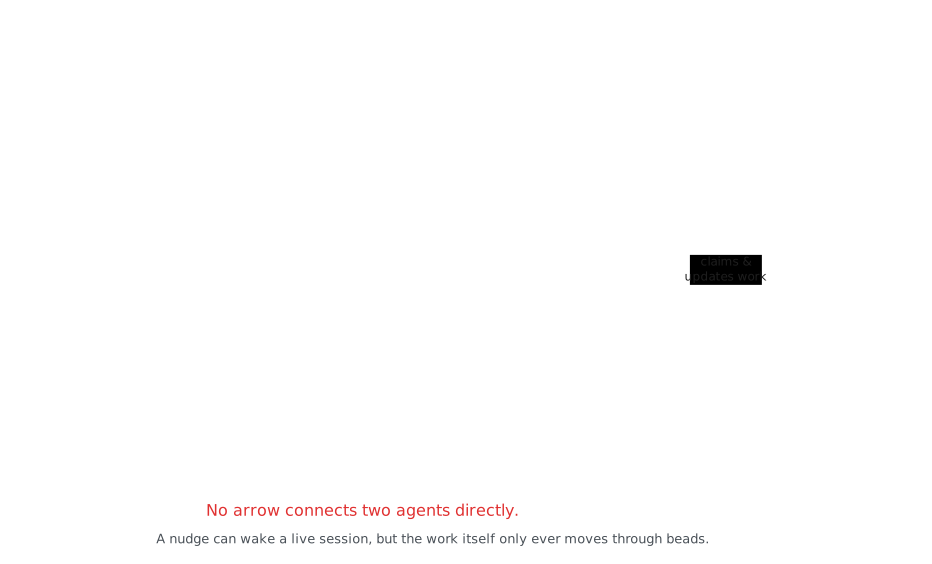
| Messaging | None between distinct agent sessions; at most a communication mechanism between subagents in the same session | Mail (a bead) + nudge (wake a live session) |
| Roles | A subagent file (.claude/agents/<name>.md) | An agent folder (agents/<name>/) |
| Identity | The one session you're in | A stable name per running agent (hello-world/pack.worker_furiosa, …) |
The rest of this page is one delta per capability — what changes when the single-agent feature becomes shared infrastructure.
Context
The window is seeded automatically, per agent, from durable sources — you never hand-assemble it.
- It starts from the agent's role: a prompt template rendered with deployment data (city, rig, working directory, branch, custom variables).
- Its current work items and mail — all beads — flow in live as it works.
State
Durable state is first-class, not something you persist by hand.
Everything is a bead: a stored work item with status,
labels, relationships, and metadata, queried live (bd, gc) — never tracked
in status or lock files that go stale on a crash. Sessions come and go; the
beads remain.
Skills
You author a skill once at a scope, and Gas City materializes it to every eligible agent — no per-agent allow-lists, and the model decides when a skill applies.
- Pick the scope:
skills/<name>/at pack level → shared with every agent in the city.agents/<role>/skills/<name>/at role level → only agents of that role (and all its pooled instances). On a name collision, the role-local skill wins.
- At startup Gas City symlinks the pack level and role level skill directories into
each agent's provider-specific skill sink —
.claude/skills/,.agents/skills/(codex),.gemini/skills/,.opencode/skills/. List withgc skill list. - It places the files into each provider's own convention; it doesn't translate them. Providers whose convention isn't confirmed (copilot, cursor, pi, omp) are skipped for now.
- No framework around skills: no per-agent allow-lists. Within a scope every eligible agent gets every skill; the model decides when one applies.
- MCP is list-only today (
gc mcp listshows what's catalogued; you wire the servers yourself).
History
History is structured and queryable across every agent, not per-session files you manage yourself.
| Layer | What it records | Read with |
|---|---|---|
| Bead history | Each work item's create → update → close trail, independent of any session — the durable memory of what was done | bd, gc |
| Session logs | One agent's conversation: your prompts, the model's replies, its tool calls | gc session logs <agent> (-f to follow) |
| Event log | An append-only, city-wide feed of system activity (sessions waking, mail sent, work created) | gc events |
Messaging
Agents that share no session still communicate, over two channels.
| Channel | Durable? | What it is | Send with |
|---|---|---|---|
Yes — a bead (type message) | Sender, recipient, subject, body; threads and waits in an inbox until read. Agents typically pull new mail into context each turn via a hook | gc mail | |
| Nudge | No | A direct poke into a live session — text typed straight into a running agent to wake or redirect it now | gc session nudge <agent> "msg" |
Roles
A role is a folder, not a single subagent file.
agents/<name>/ holds an agent.toml (provider, pool, timeouts) and a
prompt.template.md defining what that kind of agent does.
Identity
A specific running instance has a stable name you can address — across restarts.
- Each live agent has a deterministic session name (e.g.
hello-world/pack.worker_furiosa), so you and other agents can message, wake, peek at, and resume exactly that one. - One role instantiates into many identities (a pool of
worker_furiosa,worker_nux, …). See them withgc session list. - Role (the kind), identity (the running instance), and pool (the set) are all facets of the single Agent primitive — see the six primitives.
See also
- The six primitives — the canonical model; start here.
- Coming from Gas Town
- Tutorial 04: Communication — mail and nudge.
- Config Reference