本页还没有译文
本页 31 段还没译成简体中文,下面显示的是英文原文。Maxim
还没翻译译自英文(ai-sdk.dev)本页 31 段都还没译
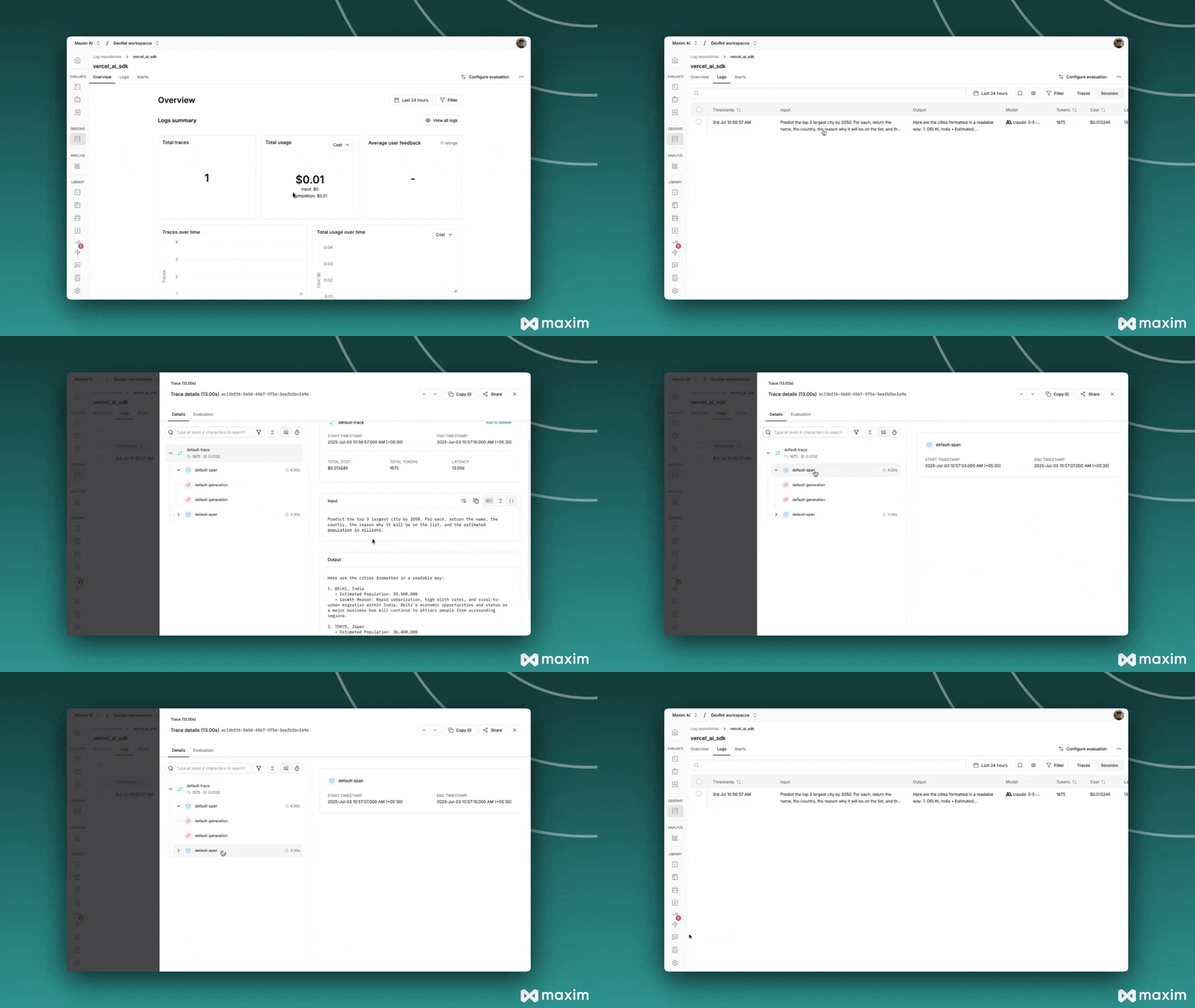
Maxim AI streamlines AI application development and deployment by applying traditional software best practices to non-deterministic AI workflows. Our evaluation and observability tools help teams maintain quality, reliability, and speed throughout the AI application lifecycle. Maxim integrates with the AI SDK to provide:
-
Automatic Observability – Adds tracing, logging, and metadata to AI SDK calls with a simple wrapper.
-
Unified Model Wrapping – Supports OpenAI, Anthropic, and Google etc. models uniformly.
-
Custom Metadata & Tagging – Enables attaching trace names, tags, and session IDs to track usage.
-
Streaming & Structured Output Support – Handles streaming responses and structured outputs seamlessly.
Setting up Maxim with the AI SDK
Requirements
"ai"
"@ai-sdk/openai"
"@ai-sdk/anthropic"
"@ai-sdk/google"
"@maximai/maxim-js"
Environment Variables
MAXIM_API_KEY=
MAXIM_LOG_REPO_ID=
OPENAI_API_KEY=
ANTHROPIC_API_KEY=
Initialize Logger
import { Maxim } from '@maximai/maxim-js';

async function initializeMaxim() {
  const apiKey = process.env.MAXIM_API_KEY || '';
  if (!apiKey) {
    throw new Error(
      'MAXIM_API_KEY is not defined in the environment variables',
    );
  }

  const maxim = new Maxim({ apiKey });
  const logger = await maxim.logger({
    id: process.env.MAXIM_LOG_REPO_ID || '',
  });

  if (!logger) {
    throw new Error('Logger is not available');
  }

  return { maxim, logger };
}
Wrap AI SDK Models with Maxim
import { openai } from '@ai-sdk/openai';
import { wrapMaximAISDKModel } from '@maximai/maxim-js/vercel-ai-sdk';

const model = wrapMaximAISDKModel(openai('gpt-6-astra'), logger);
Make LLM calls using wrapped models
import { generateText } from 'ai';
import { openai } from '@ai-sdk/openai';
import { wrapMaximAISDKModel } from '@maximai/maxim-js/vercel-ai-sdk';

const model = wrapMaximAISDKModel(openai('gpt-5'), logger);

// Generate text with automatic logging
const response = await generateText({
  model: model,
  prompt: 'Write a haiku about recursion in programming.',
  temperature: 0.8,
  system: 'You are a helpful assistant.',
});

console.log('Response:', response.text);
Working with Different AI SDK Functions
The wrapped model works seamlessly with all Vercel AI SDK functions:
Structured Output
import { generateText, Output } from 'ai';
import { z } from 'zod';

const response = await generateText({
  model: model,
  prompt: 'Generate a user profile for John Doe',
  output: Output.object({
    schema: z.object({
      name: z.string(),
      age: z.number(),
      email: z.string().email(),
      interests: z.array(z.string()),
    }),
  }),
});

console.log(response.output);
Stream Text
import { streamText } from 'ai';

const { textStream } = await streamText({
  model: model,
  prompt: 'Write a short story about space exploration',
  system: 'You are a creative writer',
});

for await (const textPart of textStream) {
  process.stdout.write(textPart);
}
Custom Metadata and Tracing
Using Custom Metadata
import { MaximVercelProviderMetadata } from '@maximai/maxim-js/vercel-ai-sdk';

const response = await generateText({
  model: model,
  prompt: 'Hello, how are you?',
  providerOptions: {
    maxim: {
      traceName: 'custom-trace-name',
      traceTags: {
        type: 'demo',
        priority: 'high',
      },
    } as MaximVercelProviderMetadata,
  },
});
Available Metadata Fields
Entity Naming:
sessionName- Override the default session nametraceName- Override the default trace namespanName- Override the default span namegenerationName- Override the default LLM generation name
Entity Tagging:
sessionTags- Add custom tags to the session(object: {key: value})traceTags- Add custom tags to the trace(object: {key: value})spanTags- Add custom tags to span(object: {key: value})generationTags- Add custom tags to LLM generations(object: {key: value})
ID References:
sessionId- Link this trace to an existing sessiontraceId- Use a specific trace IDspanId- Use a specific span ID
Streaming Support
import { streamText } from 'ai';
import { openai } from '@ai-sdk/openai';
import {
  wrapMaximAISDKModel,
  MaximVercelProviderMetadata,
} from '@maximai/maxim-js/vercel-ai-sdk';

const model = wrapMaximAISDKModel(openai('gpt-6-astra'), logger);

const { textStream } = await streamText({
  model: model,
  prompt: 'Write a story about a robot learning to paint.',
  system: 'You are a creative storyteller',
  providerOptions: {
    maxim: {
      traceName: 'Story Generation',
      traceTags: {
        type: 'creative',
        format: 'streaming',
      },
    } as MaximVercelProviderMetadata,
  },
});

for await (const textPart of textStream) {
  process.stdout.write(textPart);
}
Multiple Provider Support
import { openai } from '@ai-sdk/openai';
import { anthropic } from '@ai-sdk/anthropic';
import { google } from '@ai-sdk/google';
import { wrapMaximAISDKModel } from '@maximai/maxim-js/vercel-ai-sdk';

// Wrap different provider models
const openaiModel = wrapMaximAISDKModel(openai('gpt-6-astra'), logger);
const anthropicModel = wrapMaximAISDKModel(
  anthropic('claude-sonnet-5-5'),
  logger,
);
const googleModel = wrapMaximAISDKModel(google('gemini-pro'), logger);

// Use them with the same interface
const responses = await Promise.all([
  generateText({ model: openaiModel, prompt: 'Hello from OpenAI' }),
  generateText({ model: anthropicModel, prompt: 'Hello from Anthropic' }),
  generateText({ model: googleModel, prompt: 'Hello from Google' }),
]);
Next.js Integration
API Route Example
// app/api/chat/route.ts
import { streamText } from 'ai';
import { openai } from '@ai-sdk/openai';
import {
  wrapMaximAISDKModel,
  MaximVercelProviderMetadata,
} from '@maximai/maxim-js/vercel-ai-sdk';
import { Maxim } from '@maximai/maxim-js';

const maxim = new Maxim({ apiKey: process.env.MAXIM_API_KEY });
const logger = await maxim.logger({ id: process.env.MAXIM_LOG_REPO_ID });
const model = wrapMaximAISDKModel(openai('gpt-6-astra'), logger);

export async function POST(req: Request) {
  const { messages } = await req.json();

  const result = await streamText({
    model: model,
    messages,
    system: 'You are a helpful assistant',
    providerOptions: {
      maxim: {
        traceName: 'Chat API',
        traceTags: {
          endpoint: '/api/chat',
          type: 'conversation',
        },
      } as MaximVercelProviderMetadata,
    },
  });

  return result.toAIStreamResponse();
}
Client-side Integration
// components/Chat.jsx
import { useChat } from 'ai/react';

export default function Chat() {
  const { messages, input, handleInputChange, handleSubmit } = useChat({
    api: '/api/chat',
  });

  return (
    <div>
      {messages.map(m => (
        <div key={m.id}>
          <strong>{m.role}:</strong> {m.content}
        </div>
      ))}

      <form onSubmit={handleSubmit}>
        <input
          value={input}
          onChange={handleInputChange}
          placeholder="Say something..."
        />
        <button type="submit">Send</button>
      </form>
    </div>
  );
}
Learn more
- After setting up Maxim tracing for the Vercel AI SDK, you can explore other Maxim platform capabilities:
- Prompt Management: Version, manage, and dynamically apply prompts across environments and agents.
- Evaluations: Run automated and manual evaluations on traces, generations, and full agent trajectories.
- Simulations: Test agents in real-world scenarios with simulated multi-turn interactions and workflows.
For further details, checkout Vercel AI SDK's Maxim integration documentation.